

TACTICALEDGE
Build and deploy resilient edge systems that operate reliably in degraded edge-to-cloud environments.

Trusted by major public safety and defense institutions




Operate degraded edge-to-cloud
environments. With confidence.
A distributed platform spanning data, control and execution planes, abstracting hardware, networks, and protocols to enable software-defined edge systems across tactical environments.
Tactical Edge OS
Everything you need to build and deploy tactical edge systems that operate reliably in degraded environments.
Defense · Public Safety · Critical Infrastructure
Sensor-to-Effector Orchestration
Deterministic sensing-to-actuation pipelines across distributed edge systems.
Resilient
Edge Mesh
Distributed compute mesh for edge systems in degraded networks. (DIL-tolerant).
Multi-Domain Coordination
Fault-tolerant system for cross-domain control, tasking and execution.
Rapidly develop and deploy
tactical edge systems
Develop faster
Development per unit time is what matters. Years of development become weeks. Months of development become days.
Explore DocsDeploy in minutes
Integrate new edge adapters or onboard existing edge devices rapidly. Live devices are discovered, configured, and mission-ready within seconds.
Explore Edge AdaptersOperate undeterred
Stop fighting edge infrastructure. No constant firefighting when conditions change. Your stack keeps running — so your team can focus on building, not fixing.
Explore ArchitectureLean teams, massive impact
Hyper-enable your dev teams. Transform your software engineers into tactical edge geniuses and lead your team in fast moving industries.
Explore Engineering ToolsOwn what you build
Design intuitively in a modular, extensible, and scalable platform to deploy tactical edge systems across domains. You build it, you own it. Enable sovereign development to tactical edge computing and retain full rights to your intellectual property.
Explore Licensing
“Zequent has enabled us to deliver capabilities much faster with a very lean engineering team. Its flexibility and reliability have scaled to meet our rapidly evolving needs. After using their technology over the last year, I’m convinced Zequent is the future of tactical edge computing.”
Tim Müller, Business Development at M4Com
Speak your stack.
We handle the rest.
Up and running in three steps.
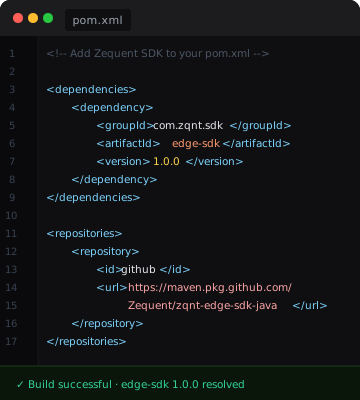
Install the SDK
Add the Zequent SDK to your project using your language's package manager. Choose the Edge SDK to connect a device, or the Client SDK to control devices from your application.
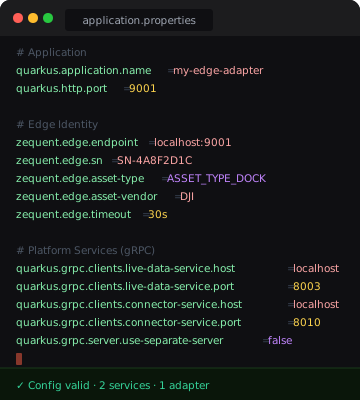
Configure Your Adapter
Declare your device identity — serial number, asset type, and platform endpoints. A single config file is all it takes to describe your edge node to the platform.
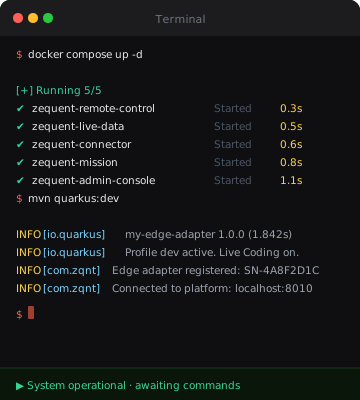
Run Zequent
Start the platform services, then bring your adapter online. It registers automatically, establishes a connection, and is ready to receive commands and push telemetry.
Intuitive by design,
engineered for reliability.
Build tactical edge systems with integrated primitives that just work.
Device Integration
Connect and control any sensor, system, or platform—without custom glue code.
Real-Time Data Streaming
Continuously ingest and distribute data across the system—without bottlenecks.
Tasking & Coordination
Assign, manage, and synchronize tasks across distributed assets.
Mission Planning & Scheduling
Plan, adapt, and execute operations in real time with optional time scheduling.
AI Inference
Run models directly at the edge—where decisions need to happen.
Continuous Learning
Capture outcomes and improve system behavior over time.
Mesh Connectivity
Maintain communication across devices—even in degraded or offline environments.
Interoperability
Work seamlessly across vendors, systems, and domains.
Stay secure and
compliant by default.
Build capabilities, not compliance.
Standards Compliance
Built to meet NATO STANAG and industry requirements—out of the box.
Audit & Traceability
Every action is logged, traceable, and reviewable—end to end.
Data Encryption
Data is encrypted at rest and in transit—by default.
Zero-Trust Security
No implicit trust. Every user, device, and action is continuously verified.
Resilient Failover
Systems continue operating through failures—without interruption.
Full Observability
Monitor system state, performance, and behavior in real time.
System Standardization
Enforce consistent structures, interfaces, and workflows across deployments.
Granular Access Control
Define exactly who can access what—down to the smallest level.